
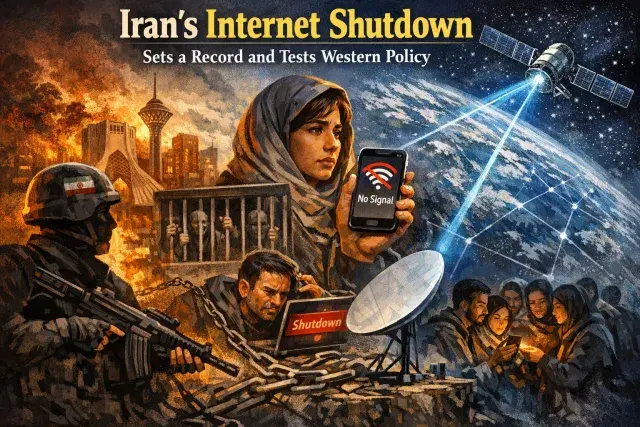

Iran is now enduring the longest nationwide internet shutdown yet documented, with the blackout nearing 50 days even after the Iran war ceasefire. That fact matters beyond censorship alone: it has cut families, journalists, and dissidents off from one another while making independent reporting from inside the country far harder.
The blackout also exposes a larger reality. In modern authoritarian crises, control over connectivity is not a side issue but a core instrument of state power, and satellite internet has become one of the few tools capable of weakening that control.
A blackout designed to isolate and intimidate
Nationwide internet shutdowns do more than interrupt access to apps or websites. They disrupt basic communication, obstruct the verification of events on the ground, and leave citizens more vulnerable to arrest, coercion, and disinformation. In Iran, that pressure is compounded by the state’s long practice of pairing digital repression with physical punishment, including arrests tied to online activity and the targeting of tools used to bypass censorship.
The accounts described in the context reflect a pattern seen in other authoritarian crackdowns: when people cannot communicate reliably, collective action becomes harder, rumors spread faster, and the state gains a decisive advantage in shaping what is seen and what is believed. For outside audiences, the result is a distorted picture of events inside the country. For those living through it, the blackout can feel more threatening than open conflict because it extends fear into every hour of daily life.
Why Starlink matters, and why it is not enough on its own
Starlink’s remaining links inside Iran have become a rare channel for uncensored communication, which helps explain why the authorities have moved to confiscate terminals, arrest users, and jam signals. Low-Earth-orbit satellite internet is harder for a state to suppress completely than conventional terrestrial networks because it does not depend on a national backbone controlled at a few chokepoints. That makes it strategically important not only for civilians under repression but also for governments that see open access to information as a security interest.
Still, the technology has limits. Physical terminals are expensive, risky to possess, and vulnerable to signal detection and jamming. Direct-to-cell service offers a different path because it could reach ordinary smartphones without requiring separate hardware, but current capabilities are narrower than full broadband access. Text, basic media, and some calling functions can matter enormously during a blackout, yet they do not fully replace the ability to upload and verify high-volume video from the ground.
The policy opening is in Washington, not Tehran
The most immediate barrier to wider satellite access is not simply technical. It is also regulatory. The article’s central policy argument is that the United States has tools available, including emergency communications licensing and sanctions carveouts for internet freedom services, that could make it easier to expand lawful access for Iranians. If officials regard digital access in authoritarian emergencies as part of democratic resilience and national security, then treating satellite connectivity as critical infrastructure follows naturally.
That would require a layered approach rather than a single fix: wider support for satellite-based phone connectivity, continued efforts to get higher-capacity terminals into the country, and funding for anti-censorship tools that reduce surveillance risk. None of those measures would eliminate danger for users. They would, however, raise the cost of repression by forcing the Iranian state to spend more resources on blocking, jamming, confiscation, and monitoring.
A test case for internet freedom in authoritarian states
Iran’s blackout is a warning about the future of digital repression. Governments do not need to seal borders completely if they can sever networks, flood the information space with propaganda, and punish the small number of people still able to transmit evidence. The longer this shutdown continues, the clearer it becomes that access to communications technology now sits at the center of human rights, crisis reporting, and geopolitical competition.
For the United States and its allies, the lesson is broader than Iran. Autocratic governments have learned how to weaponize telecommunications infrastructure. Democracies are now being forced to decide whether keeping people connected is humanitarian support, strategic policy, or both.
