
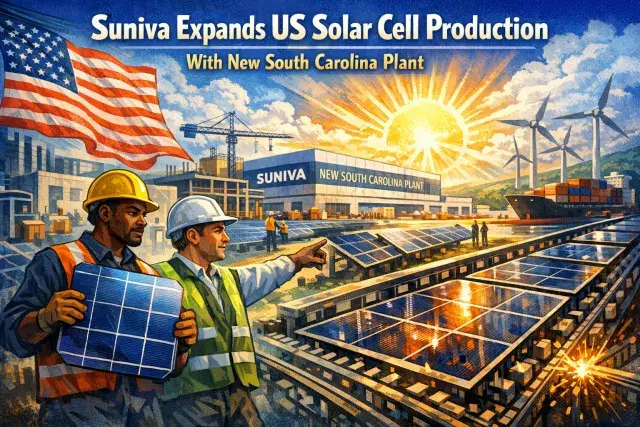

Suniva plans to build a 4.5-gigawatt solar cell factory in Laurens, South Carolina, a move that would push its total US cell capacity above 5.5 GW a year when the site opens in the second quarter of 2027. The project matters well beyond one company: it signals a larger effort to rebuild a domestic solar supply chain in a market where manufacturing capacity has long been concentrated overseas.
A large bet on domestic manufacturing
The planned facility will span 620,000 square feet and carry more than $350 million in investment, according to the company. Suniva says the plant will create more than 550 jobs in advanced manufacturing and clean energy, adding industrial employment to a sector that has often depended on imported components even as US solar deployment has grown.
Once online, the South Carolina factory and Suniva’s existing metro Atlanta operation would make the company the largest merchant solar cell manufacturer in the United States, by its account. That merchant role is important. It means Suniva is positioned to sell cells into the broader market rather than only feeding an in-house module business, which could give domestic panel assemblers another US source for a critical input.
Why solar cells matter in the supply chain
Solar cells sit at the heart of a panel, converting sunlight into electricity. They are also one of the harder pieces of the solar manufacturing chain to localize. Building panels domestically is one step; producing the cells that go inside them is another, more technically demanding one. A new cell plant can help narrow a longstanding gap between US demand for solar equipment and US capacity to make the core components.
Suniva makes monocrystalline silicon cells, the dominant technology in today’s solar market because of their high efficiency and wide commercial use. For policymakers and manufacturers alike, expanding cell production in the US is tied to a broader concern: a clean energy system is not only about installing more generation, but also about who makes the equipment and where supply bottlenecks can emerge.
From bankruptcy to expansion
Suniva’s history gives the announcement extra weight. The company traces its roots to Georgia Tech research backed by the US Department of Energy and has operated since 2007. It filed for bankruptcy in 2017, then reemerged in 2023, making this expansion both an industrial investment and a marker of how quickly the economics and politics of domestic solar manufacturing have shifted.
Chief executive Tony Etnyre cast the project as part of a national energy strategy, arguing that solar is the fastest and most economical way to expand the country’s energy supply. President and chief operating officer Matt Card framed the decision in terms of energy independence and control over supply chains. Those arguments reflect a wider debate in US industrial policy, where energy security now includes not just fuel production and grid reliability, but manufacturing capacity for clean energy technologies.
What the South Carolina project could signal
The new factory will not by itself remake the US solar market, which remains deeply connected to global production. But it does point to a more mature phase of domestic manufacturing, one focused on upstream components rather than only final assembly. If projects like this move from announcement to operation on schedule, the US solar sector could become less vulnerable to trade disruptions, shipping delays, and concentrated foreign supply.
That is the promise behind Suniva’s Laurens plant: more domestic output, more control over a strategic technology, and a stronger industrial base tied to the energy transition. The harder test will come over the next several years, when financing, construction, hiring, and market demand determine whether this manufacturing push can endure.